
5.4 KiB
title, source, author, published, created, description, tags
| title | source | author | published | created | description | tags | ||
|---|---|---|---|---|---|---|---|---|
| Why I Prefer “import x” Over “from x import y” | https://levelup.gitconnected.com/why-i-prefer-import-x-over-from-x-import-y-b1ae8be6cbdd |
|
2024-05-18 | 2024-10-29 | ^ we can import the entire module b, and the use b.<function_name> to access the individual functions defined in b.py Here, when we use the functions defined in b.py, we need to put the module name b… |
|
[

](https://zlliu.medium.com/?source=post_page---byline--b1ae8be6cbdd--------------------------------)
[

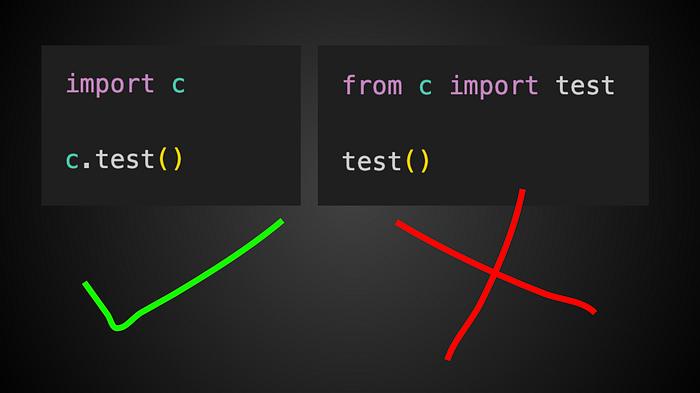
Both ways are correct, but one way is more correct than another. In my opinion, at least.
Importing in Python
Let’s say we have 2 Python files:
a.pywhich we run directly using the commandpython a.pyb.pywhich contains functions that are imported intoa.py
def test(): print('test')def hello(): print('hello')
^ there are 2 main ways to import the functions from b.py into a.py
1) import b
import bb.test() b.hello()
^ we can import the entire module b, and the use b.<function_name> to access the individual functions defined in b.py
Here, when we use the functions defined in b.py, we need to put the module name b beforehand eg b.test() or b.hello()
2) from b import
from b import test, hellotest() hello()
^ alternatively, we can also use from b import test, hello to import the functions directly.
Here, we don’t need to put b before our function name — we can use the function name directly.
Why I prefer ‘import b’ over ‘from b import test, hello’
1) Namespace issues
When we use import b instead of from b import test, hello, we are less likely to have a clash in namespace.
def test(): print('test')def hello(): print('hello')
test = 'apple'from b import test, hello
^ when we from b import test, hello inside a.py, we directly use the test and hello variables. If we are not careful, we might accidentally override any existing test and hello variables.
testis already defined ina.py- when we
from b import test, we importtestfromb.py testfromb.pyoverrides the originaltestfroma.py
Note that this problem gets exponentially worse as our Python scripts become increasingly complicated, containing more and more variables that might clash with each other.
def test(): print('test')def hello(): print('hello')
test = 'apple'import bb.test()b.hello()
^ however, if we use import b, we need to use b.test() in order to access the test function inside b.py
This does not in fact clash with our original test variable in a.py as they are using different namespaces. Which means that we are much less likely to accidentally override our variables.
2) Less clutter
I firsthandedly experienced this recently at work.
def doSomethingHappily(): passdef doSomethingSadly(): passdef doSomethingAngrily(): passdef doSomethingQuickly(): passdef doSomethingSlowly(): passdef doSomethingElse(): pass
^ I had a bunch of functions (with pretty lengthy names) in b.py, and I needed to import them into a.py
from b import doSomethingHappily, doSomethingSadly, doSomethingAngrily \ doSomethingQuickly, doSomethingSlowly, doSomethingElsedoSomethingHappily()doSomethingSadly()doSomethingAngrily()doSomethingQuickly()doSomethingSlowly()doSomethingElse()
^ this was what my import statement was like. Some problems:
- there was lots of clutter and this took up lots of random space
- if I changed a function name, I needed to change it multiple times in
a.pytoo - which got annoying pretty quickly
Instead, I refactored my import statement to import b
import bb.doSomethingHappily()b.doSomethingSadly()b.doSomethingAngrily()b.doSomethingQuickly()b.doSomethingSlowly()b.doSomethingElse()
- my import statement no longer spanned multiple lines
- when I modified a function name, I no longer had to change this in multiple places
Why not “from b import *”?
This is bad practice, so while this is legal code, chances are the the senior devs might not want this around.
But why is this bad practice? from b import * means import everything from inside b.py. Which means we are even more likely to accidentally override some variables in our namespace now.
As good practice, we should ideally import only what we need rather than every single thing inside a module.
Conclusion
Hope this was clear and easy to understand
If You Wish To Support Me As A Creator
- Clap 50 times for this story
- Leave a comment telling me your thoughts
- Highlight your favourite part of the story
Thank you! These tiny actions go a long way, and I really appreciate it!
YouTube: https://www.youtube.com/@zlliu246
LinkedIn: https://www.linkedin.com/in/zlliu/
My Ebooks: https://zlliu.co/ebooks