
14 KiB
title, source, author, published, created, description, tags
| title | source | author | published | created | description | tags | ||
|---|---|---|---|---|---|---|---|---|
| Dungeons and Dragons and Sexual Harassment | https://aninjusticemag.com/dungeons-and-dragons-and-sexual-harassment-a5ee012f227f |
|
2024-08-20 | 2024-10-29 | The “magic” of Dungeons and Dragons (D&D) is created through choices made by both the Dungeon Master (DM) and the players. Players go on an adventure together, usually in a Tolkienesque fantasy… |
|
Nonfiction
Isn’t it obvious why there aren’t more women playing TTRPGs?
[

](https://clawrenc.medium.com/?source=post_page---byline--a5ee012f227f--------------------------------)
[

](https://aninjusticemag.com/?source=post_page---byline--a5ee012f227f--------------------------------)
Photo by Cassiano K. Wehr on Unsplash
The “magic” of Dungeons and Dragons (D&D) is created through choices made by both the Dungeon Master (DM) and the players. Players go on an adventure together, usually in a Tolkienesque fantasy setting, using dice to determine outcomes.
For example, a character might say, “I attack that orc with my sword,” and roll a D20 (20-sided dice). If they roll high enough, they get to decrease the enemy’s hit points. If they roll too low, they miss, and the DM narrates what happens next.
Your choices actively determine the story, with the help of the DM and the dice. The world is what you make it, basically.
So why are these worlds so often toxic to female players?
A one-time thing
In my very first game of D&D, we played a “one-shot” — a story told all in one sitting — with pre-made characters to get used to the mechanics. I was the only woman in a group of guys, including my husband.
The DM set up a scenario with the hopes that our characters would essentially break into two “teams.” A party was happening at a nearby manor and some bad guys wanted to steal a MacGuffin; half the players would be working with the thieves, and the other half to protect the item.
My character was supposed to be on the protect-the-item “team,” and so I made the choice to eavesdrop on a conversation Brian’s character, Pervy Wizard, was having with the bartender of a tavern about the item.
Note: Pervy Wizard did not have to be pervy. He became pervy based entirely on choices made by Brian, the person playing him.
Pervy Wizard rolled high enough to notice me on a perception check. Rather than confront my character, or ask me to join his quest to protect the item, or any of the infinite number of options he had —
PW made a comment to the bartender about my fictional character’s body. I believe it was something like, “Check out that hot piece of ass!” and a wolf whistle. He then asked to roll an attack to pinch my fictional butt.
The DM shut that shit down, but as a direct result of this interaction, we never formed a team. For the entire one-shot, I was on my own — which is not the best way to play D&D.
I explored the manor on my own. I looked for the item on my own. I battled a guard on my own. I tried to climb a wall, fell off, and almost died because I was down so many hit points from battling a guard on my own.
The story was really unsatisfying. The DM had to run three encounters simultaneously instead of two, and when the two main groups finally met up in a confrontation over the item, I wasn’t even there.
In the end, Brian made some really stupid choices, including trying to switch teams in the middle of the big showdown. Pervy Wizard was promptly chopped in half by an enemy, which at least offered closure for my character— or would have, if she’d been there to see it…
Photo by Gian-Luca Riner on Unsplash
This first experience playing D&D was a off-putting, but I liked the game itself, my husband had a great time, and our DM was sympathetic, so I bit my tongue. After all, I thought, the dynamic was just a one-time mishap, part of a one-shot, and wouldn’t be an issue if I kept playing.
The campaign
I worked with the DM to build my character for our main campaign, a game that would hopefully continue for several months. Some players use the same character for years, if a group manages to continue scheduling sessions to play together.
Worried that the dynamic established in our one-shot would taint the atmosphere for future games, I altered my behaviour to change the vibe at the table. I didn’t want to make it a “thing.” I wanted to be Cool Girl. Or really, I wanted to play D&D, and the way to do that was to be Cool Girl.
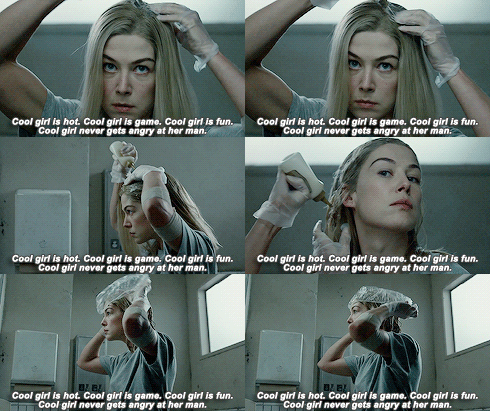
GIF from “Gone Girl,” © 20th Century Studios
My new character, Dipsy Flickerbean, was a deliberately uncomfortable one: a gnome bard with gigantic boobs and a disturbingly childlike face and voice, like an anime character. I leaned into the thing that made me anxious — the idea of getting sexualized — and made her whole premise pervy in a way I controlled through my choices.
I loved Dipsy. She could keep up with the boys and was explicitly gay, so there was no possibility of any men trying to romance her. Better yet, my bard’s “talent” was performing dirty limericks, so I could out-perv any potential perving at the table.
I thought I had fixed the problem.
But then things got weird again.
One of the first interactions between Dipsy and Brian’s new character was him loudly accusing my character of being a “prostitute sent to seduce him” at Pervy Wizard’s funeral (RIP). The crowd turned on him instantly. We all laughed.
At first, I thought this was a bit of a self-deprecating improv — Brian was playing a “vegetarian vampire” described as a “fruit bat,” a squeamish, effeminate elf from a wealthy background. I thought the joke was that his character was a gay man pretending to be a hetero guy, which wasn’t the best “joke character,” but at least was better than Pervy Wizard.
It was not better than Pervy Wizard. From the first session, Fruit Bat’s behaviour ranged from subtle microaggressions to overt harassment. He made excuses to touch my character, to comment on her body, and to unironically sexualize her at every turn. He also acted this way toward female NPCs (non-player characters).
It finally came to a head when, during a fight, Fruit Bat went down (to zero hit points) and I cast the spell Cure Wounds, which required me to touch him. I narrated this as performing CPR. Fruit Bat gasped comically into consciousness then immediately narrated how “seeing my breasts in his face” during CPR caused him to “pass out again” and nosedive into my character’s cleavage. He made motorboat sounds.
After that session, I asked the DM to intervene. Brian cut back on the dirty jokes and things were okay for a session or two. But then Brian made a point of claiming that his character had had a sexual awakening and was now gnome-sexual.
Great.
The other players weren’t as bad, but occasionally piled on when Brian started his antics. “Adult” jokes are a pretty common feature of D&D. I didn’t want to be the buzzkill, especially since most of the time, I was having fun.
I was fine with a character “rolling for penis size” to intimidate an enemy, or dumb jokes about a sword wound accidentally circumcising someone. Some of it was funny.
But I felt like I was being treated differently — especially by Brian — whenever I did or said anything. I became reluctant to draw attention to myself, knowing that an inappropriate comment would be the result.
The vibe at the table was strained.
Eventually, we stopped playing together. The timing wasn’t working out for scheduling sessions, then someone moved and the group disbanded. We ended our months-long campaign on a cliffhanger, with our party trapped in an enemy camp.
And I was relieved.
Photo by Carlos Felipe Ramírez Mesa on Unsplash
I wish my story was a unique one, but apparently harassment in TTRPGs is a common problem. Vice ran a story a few years ago with the title “#NotAllRolePlayers” about a DM attempting to role-play sexual fantasies with a player who had rejected his real-world advances.
You can never Cool Girl enough in these situations. Either you go along with a scenario that makes you deeply uncomfortable (or even unsafe), or you’re the Frigid Bitch Who Can’t Take a Joke.
Fantasy means different things to different people
According to Dr. Justin Dyszelski’s PhD thesis on gender dynamics in TTRPGs, more than 55% of female players have been “made to feel uncomfortable, judged, or harassed because of their gender.” It’s been almost two decades since this was written, and I fear that little has changed.
Sexual violence and misogyny are often part of fictional worlds to make them “dark” and “gritty” — when female characters exist at all.
Frequently, even extremely triggering topics like rape and incest are included as part of fantasy settings for “historical realism” — as if elves and orcs are historically accurate. Worst of all is when sexual violence is played for some sort of “comedy”:
A guy who normally didn’t play with us was acting as a sort of “DM’s helper” by playing an NPC [Non-player Character]. He used the NPC’s superhuman strength and power to rape and murder my character, which he thought was really funny (Dyszelski, 2006: 121–2).
In both the Vice article and Dyszelski’s study, many players reveal that they’ve witnessed fictional sexual violence at their D&D tables. Vice reports that sexual violence in TTRPGs, and particularly fictional rape (whether of player’s characters or NPCs), is “controversial” because that violence is “always at the hands of either another party member or a character controlled by the Dungeon Master.”
==It is== ==always== ==a deliberate choice to include sexual or gender-based violence in a TTRPG. The same holds true for misogyny, homophobia, and racism; the fantasy setting can be anything the DM and players want it to be, and the world doesn’t== ==have== ==to include those things.==
So why is it so common?
The origins of Dungeons & Dragons is steeped in misogyny — and not just from toxic players and DMs. The game itself was created by a self-described “biological determinist” who believed “male and female brains are different” and thus created D&D as a deliberately male fantasy:
According to Vice, creator Gary Gygax said that while the game wasn’t “designed to exclude women,” there was no question for him that “females do not derive the same inner satisfaction from playing games” as men, and therefore didn’t consider women/their needs when creating D&D. The Vice article argues that
[Gygax’s] opinions, while fairly in line with the overwhelmingly male niche culture of war games that laid the groundwork for D&D in the early 1970s, have helped enshrine a legacy that the game has had difficulty leaving behind.
But people are trying to leave it behind — and so is the company that now owns D&D, Wizards of the Coast (which itself is now owned by Hasbro).
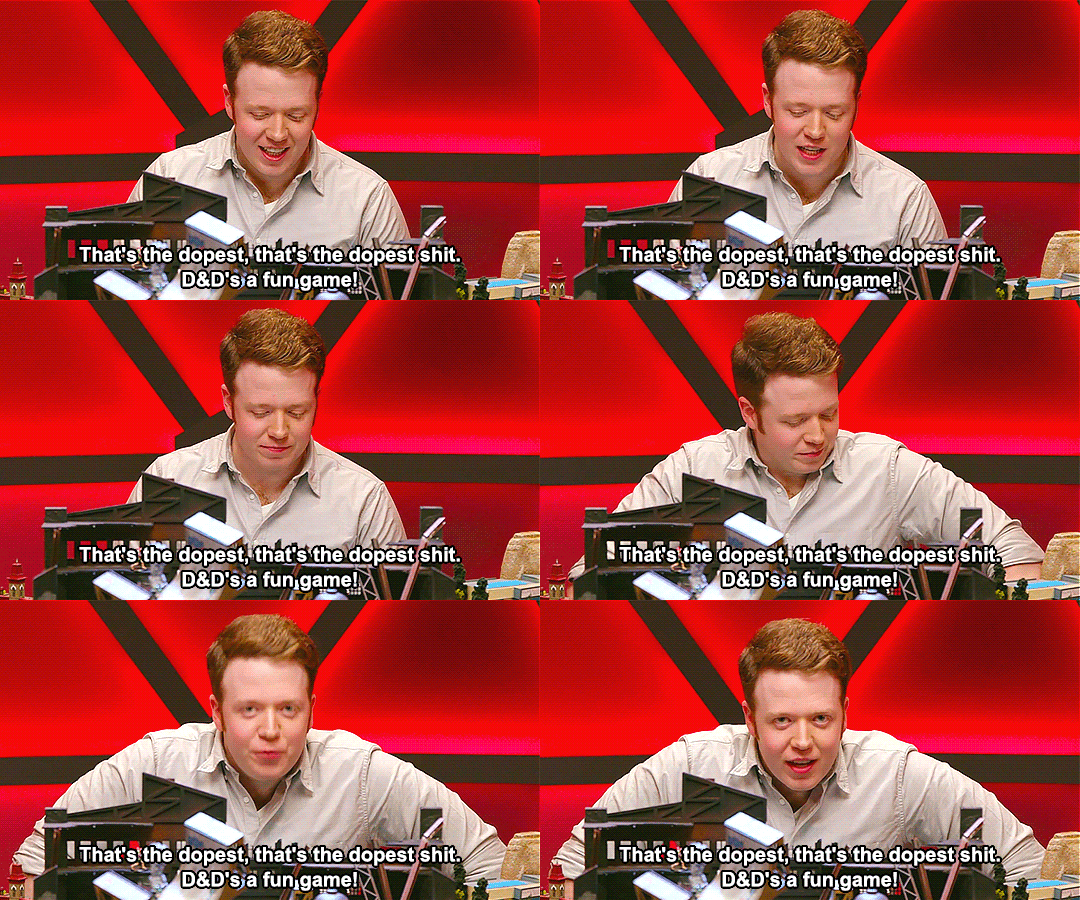
GIF of Brennan Lee Mulligan on Dimension20 © Dropout.tv / CH Media
Getting out from under Gygax
As of the 5th edition (5e), the tone of D&D has shifted. The 5e rulebook notes that players need not “be confined to binary notions of sexuality and gender,” which is a far cry from the game’s origins as a male violence fantasy. Overall, the source material is more inclusive and welcoming, with an emphasis on consent and collaboration.
In the 1980s, the estimated number of female D&D players was about 2.3%. A survey in 2000 saw that number rise to 20%, and I suspect it has probably doubled by the 2020s, with the popularity of “Actual Play” shows like Dimension20 and Critical Role.
I fell in love with D&D from watching Brennan Lee Mulligan DM for a diverse cast of comedians on Dimension20. His games are inclusive, thoughtful, and welcoming. The quality D&D content available now set my expectations pretty high, and I was let down that my home game didn’t feel the way I expected.
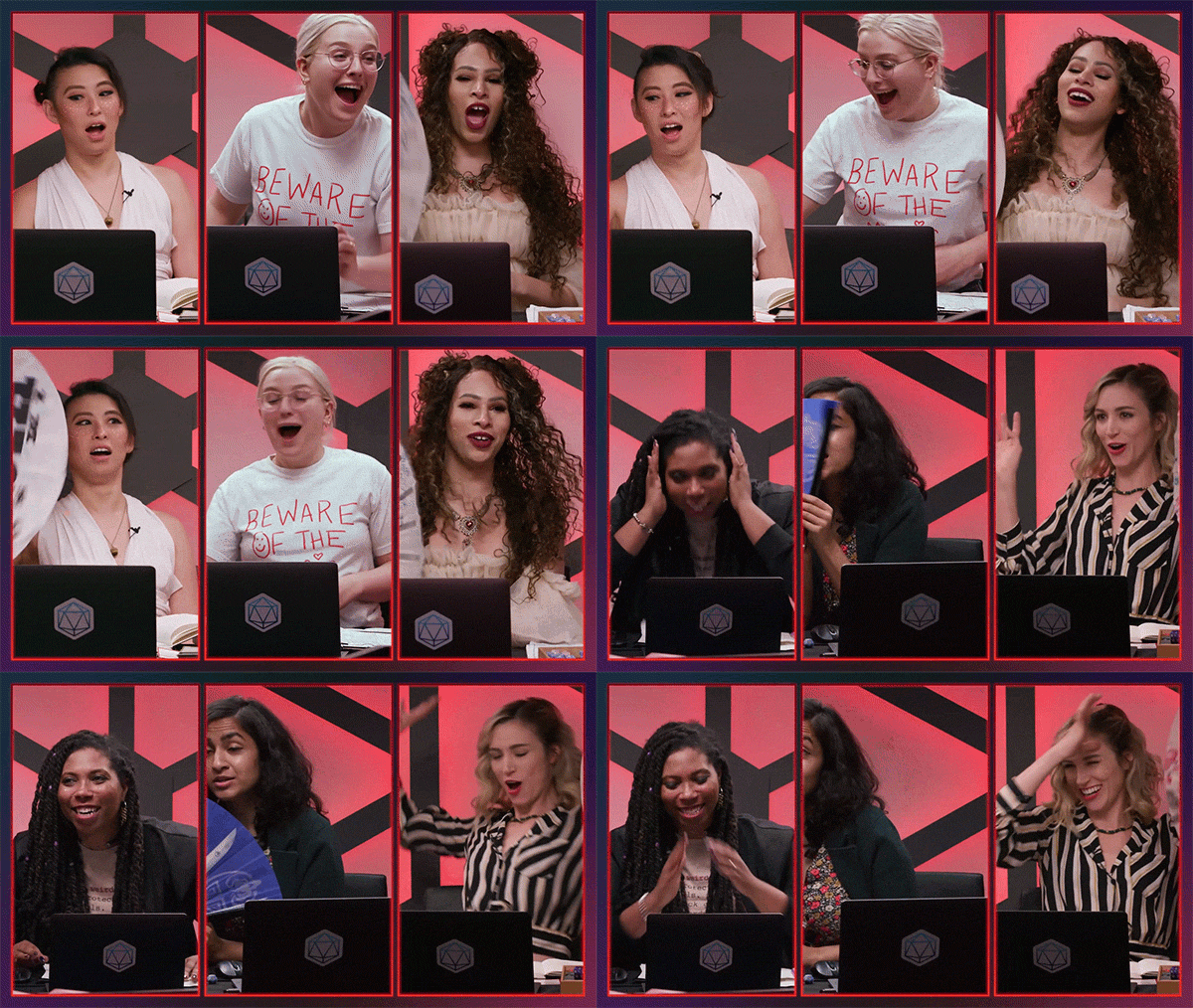
GIF from “The Seven” on Dimension 20 © Dropout.tv / CH Media, starring Aabria Iyengar, Rekha Shankar, Becca Scott, Erika Ishii, Isabella Roland, and Persephone Valentine as the Seven Maidens.
The roots of the game are misogynistic, and that’s hard to avoid, even using the rebranded, post-Gygax material. Because I was both a new player and “just someone’s wife,” I didn’t protest as vocally as I wish I would have when I was uncomfortable.
The vibe of the table is what players and the DM collaboratively make it. Choosing to role-play with people who want the same kind of experience as you is essential to getting the most out of a hobby that requires a huge investment of time, energy, creativity, and even money.
Unfortunately, it’s not always easy to find a group of people to play D&D with at all, let alone one that feels safe and welcoming. I hope to one day find my ideal group and explore that world again, but for now, I have to settle for watching other people play.