
17 KiB
title, source, author, published, created, description, tags
| title | source | author | published | created | description | tags | ||
|---|---|---|---|---|---|---|---|---|
| The Grim History of Slut-Shaming | https://medium.com/grimhistorian/the-grim-history-of-slut-shaming-d053c5986801 |
|
2023-03-07 | 2024-10-29 | On June 28th, 1887, on a warm summer evening, twenty-three-year-old Elizabeth Cass was strolling down Regent Street in London. New to the city, Elizabeth was heading towards a shop to buy a new pair… |
|
From Cleopatra to Charity Girls, sluts have always been dangerous creatures.
[

[

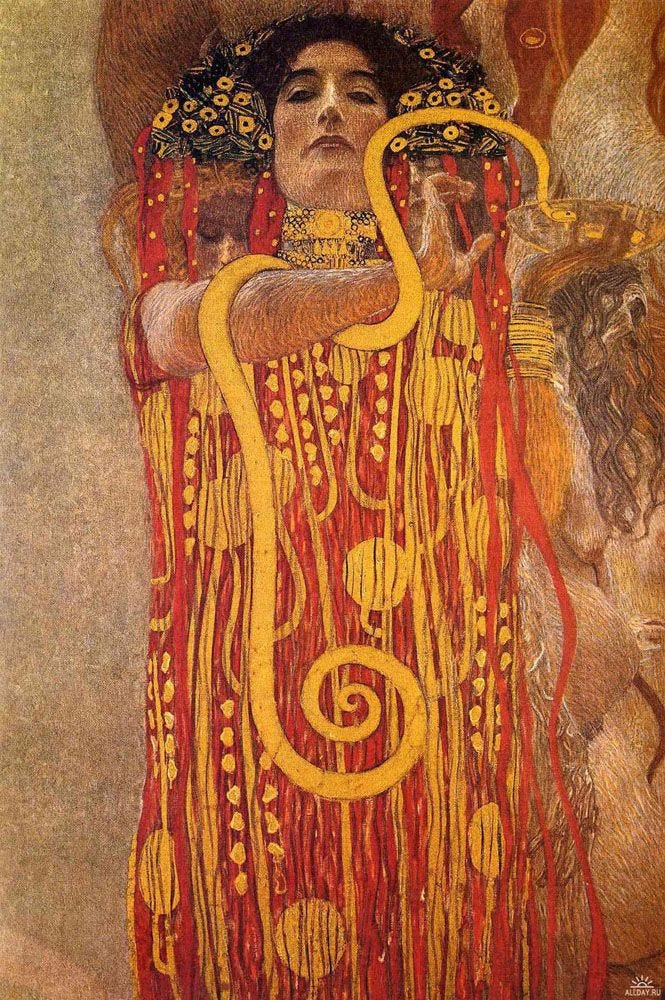
Gustav Klimt, Hygieia, Portion of Klimt’s painting Medicine, 1901–1907 | Public Domain

On June 28th, 1887, on a warm summer evening, twenty-three-year-old Elizabeth Cass was strolling down Regent Street in London. New to the city, Elizabeth was heading towards a shop to buy a new pair of gloves. As she walked, she couldn't help but feel like someone was watching her.
As Elizabeth made her way through the bustling crowds, she suddenly felt a vice grip on her arm. She spun around and faced a tall menacing police officer.
"I want you," said PC Bowden Endacott.
At first, Elizabeth was indignant. What right did this police officer have to manhandle her?
But Endacott was not just any police officer. He was a zealous enforcer of The Contagious Diseases Act, which allowed officers to arrest women suspected of prostitution. Endacott reputedly arrested three or four (alleged) prostitutes a week.
The Contagious Diseases Act was first passed in 1864 by UK Parliament to prevent venereal diseases within the armed forces. According to hospital records, one in five army men was infected with syphilis alone. With such high numbers, Parliament became desperate to contain its spread.
Consequently, the legislation allowed police officers to arrest women suspected of prostitution. Once arrested, the women endured invasive medical examinations, and if they were found to be infected, would be confined in a lock hospital until they recovered — sometimes for as long as a year.
Men, on the other hand, were never arrested or detained for soliciting prostitutes or for having venereal diseases.
Endacott claimed to have been watching Elizabeth from afar before he accused her of soliciting. Of course, Elizabeth couldn't understand how a young woman shopping alone on Regent Street could be mistaken for a prostitute. As she was dragged away by the officer, she had no idea what fate awaited her.
Elizabeth was taken to the police station, where she was to be detained overnight. Fortunately, her employer, Madame Bowman, spoke up for Elizabeth, vouching for her respectability. The charges were dismissed.
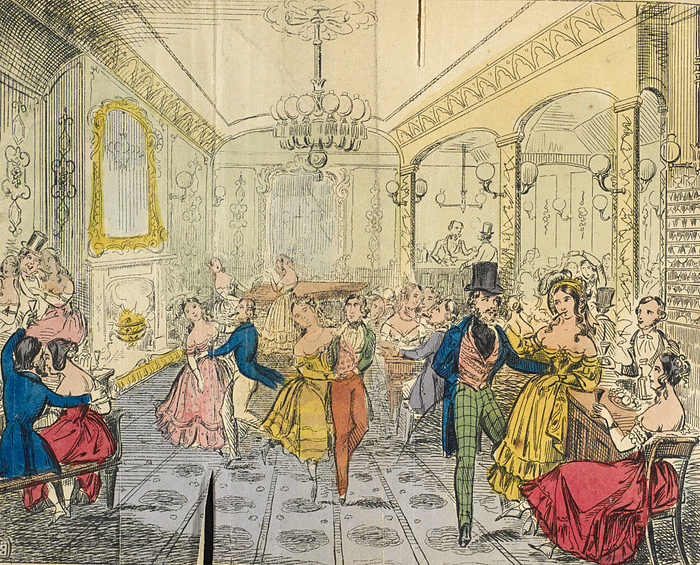
The Swell's Night Guides, Public Domain
Elizabeth was lucky. But thousands of other women yanked off the streets were not.
The case left a lasting impact on public opinion and shined a harsh black light on the mistreatment of working-class women by the Metropolitan Police. It also threw gasoline on a debate that is as common today as it was in Victorian London — was an unchaperoned woman navigating a dangerous public space asking for trouble? And if a woman wanted to walk alone, did she first need to conform to the ideals of respectability?
Of course, the notion that a woman must "conform to the ideals of respectability" has a different name today — slut shaming.
“Death is the fairest cover for her shame.” — Much Ado About Nothing, Act 4 Scene 1
The First Sluts Were Not Sexualized
Centuries ago, the word "slut” had a very different meaning. It referred to a woman who was dirty, untidy, or lazy. Chaucer even used "sluttish” to describe men, but it was primarily used to shame lower-class women who didn't keep up with their domestic responsibilities. For example, the phrase "slut's pennies" described the hard knots in bread from a housewife's poor kneading, and "slut's wool" was the dust left on the floor. So, essentially, if you didn’t keep your bread kneaded and your house clean, you were a slut.
This association with untidiness continued for centuries, even up to the eighteenth century when Samuel Johnson's dictionary defined a slut as a lazy housekeeper. In the nineteenth century, it also described dirty animals like dogs or pigs.
It wasn't until the 1960s that "slut” took on its current meaning of a sexually amoral woman.
Today, when someone calls a woman a slut, it's not because she is dirty or undomesticated. It's because she's dared to take pleasure from her sexuality.
Throughout history, sluts have been dangerous creatures. A slut dressed provocatively, spoke candidly, and sated her sexual appetite. But that brazenness often came at a price — public condemnation, loss of social status, and sometimes even death.
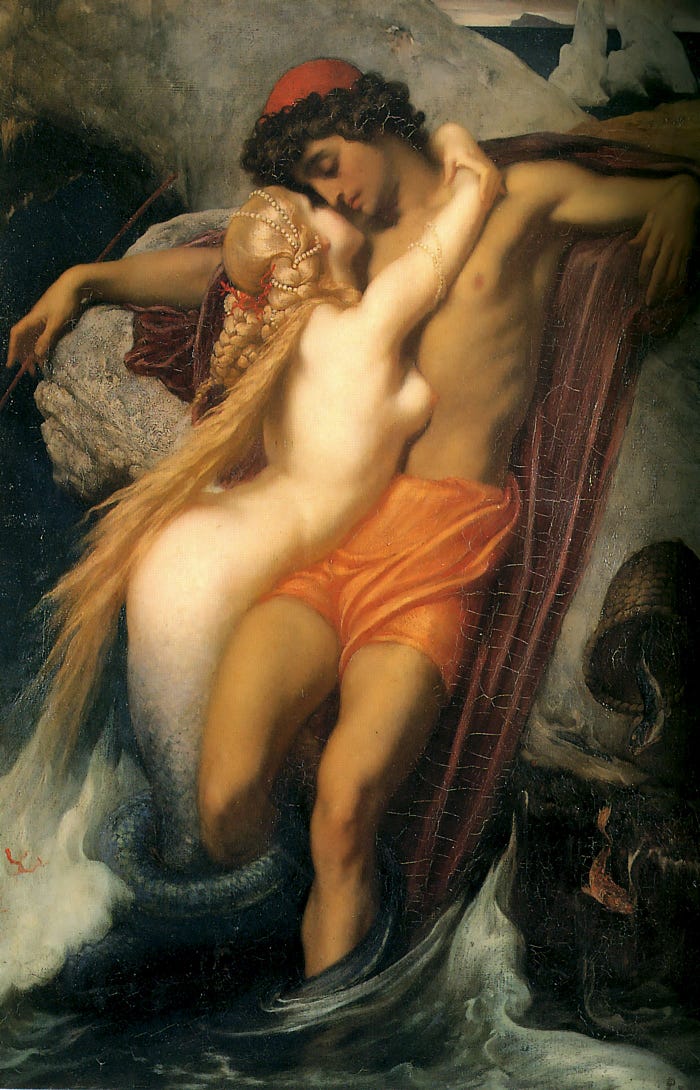
Leighton-The Fisherman and the Syren-c. 1856–1858 | Public Domain

Those Siren Temptresses of Antiquity
In Ancient Rome, there were some serious double standards surrounding sex. In 18 BC, Emperor Augustus became Rome's morality police and passed Lex Julia or “Julian Laws,” making adultery a crime. Cheating wives could be publicly shamed, exiled, or even put to death.
And who was responsible for doling out the punishment? Well, if you were a daughter, your dear old dad had that honor. Husbands were instructed to divorce their adulterous wives instead of going straight for the kill, but the courts tended to be pretty lenient if a husband lost his temper.
Now, if a husband strayed, his wife couldn't defame his character or bring him to court. Later laws allowed wives to quietly divorce cheating husbands, but men faced far less severe financial consequences than women did.
Julian Laws also affected men's attitudes toward women. Since women were seen as the gatekeepers of sexual morality, men began to view them with suspicion and even contempt. This attitude was reflected in Roman literature, where women were often portrayed as jezebels who led men astray or, worse, as ruthless Deliahs, cutting away men's virility.
But sluts were not only feared because they led men out of Eden. ==Sluts were feared because they conquered Eden.== Cleopatra cemented her power through brilliant statecraft, but she is remembered as a manipulative she-devil who used her feminine wiles to control Julius Caesar and Mark Antony, ultimately leading to their downfall. In fact, Cleopatra's seductive powers were so potent that she was often blamed for the destruction of the Roman Republic. Now, that's one femme fatale.
Shame. Shame. Shame…Those Medieval Mavens
In times of yore, the Church had a whole list of sins considered major no-nos. These sins were divided into two categories: venial sins and mortal sins. Venial sins were the lesser of the two evils and included things like lying, gossiping and being a bit of a glutton. Mortal sins, on the other hand, were the biggies — the ones that could send you straight to hell in a handbasket if you didn't confess and repent.
And guess what sin was at the top of that list? You guessed it — sex or what the Church called "carnal sin."
Now, couples could get frisky, but they had to do it within the bounds of holy matrimony with the sole purpose of procreating. Pre-marital sex, adultery, and even a little bit of self-love were not condoned.
The Church had some especially whacked beliefs about the world's oldest profession. On the one hand, it begrudgingly accepted that prostitution was a necessary "boys will be boys" evil. But, it also wanted to keep a tight leash on people's sex lives to maintain its moral high ground.
The solution? Public shaming. Well, public shaming of women, that is. Women of ill repute were made to traipse through the streets wearing striped hoods and holding white rods as symbols of their licentiousness.
But for repeat offenders, punishments were more severe. Those brassy strumpets were stripped naked and forced to ride a horse backward, facing its hindquarters — the ultimate symbol of shame back then. Apparently, looking at an ass made you an ass.
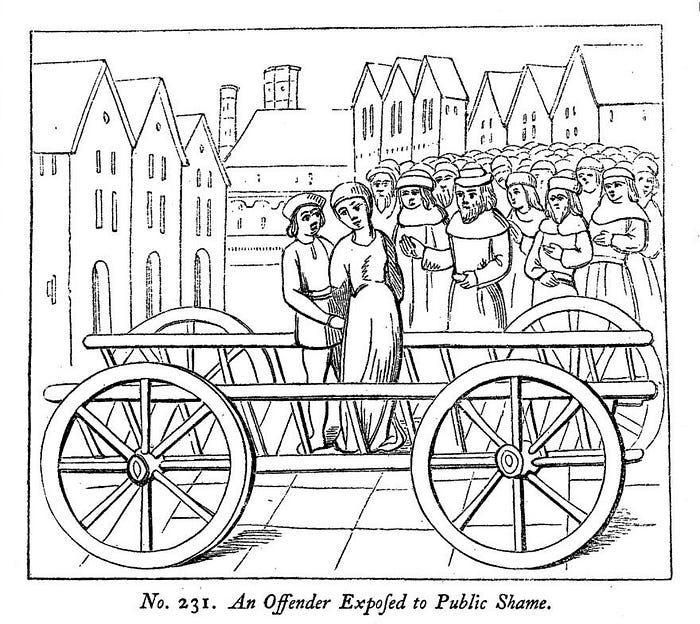
Wright, Thomas, 1810–1877 | Public Domain
The punishments were also creative for societal ladies who flouted morals. Those women were forced to confess their carnal sins to a congregation while wearing a white garment symbolizing their shame and a white paper mitre with their sins written on it.
Other times promiscuous women were locked up in a convent to atone for their sins. And if a woman had a child out of wedlock, society shunned her for the rest of her life.
Now, let's talk about the guys. Horny men were still punished but weren't treated as harshly as women. How could they be? It was the harlot's fault for tempting the man. Or so the logic went.
One common punishment for randy men was to go on a pilgrimage to a holy site. They might also be excommunicated from the Church, but this was less common than it was for women.
So to recap. Promiscuous men were sent on vacation. Promiscuous women were sent to a nunnery.
Much To Do About Dancing
By the sixteenth century, slut-shaming was as commonplace as head lice and questionable medical practices. Even Shakespeare got in on the action with plays that highlighted the fallen woman trope.
Outside of literature, women suspected of being unchaste were forced to undergo a physical examination to determine their virginity. This examination could involve a male physician inserting his fingers into the woman's vagina to check for the presence of a hymen — a test that does not indicate if a woman has had penetrative sex.
Furthermore, women who engaged in pre-marital sex could be publicly whipped, branded, or even sentenced to death. Often these women's sexual powers were so feared that they were accused of sorcery (aka witchcraft). Even today, seductive women are still described as "beguiling, bewitching, or enchanting" — words that imply a woman's sexuality is wicked.
Young adults fought back against the stigmatization. In Puritanical America, young people skirted sexual mores with "junketing." With junketing, a group of girls and boys gathered to laugh, dance, tell bawdy jokes, and sometimes engage in sexual hi-jinx.
But it was the dancing part that really got authorities thumping their bibles. Salem’s Puritan preacher, Increase Mather, warned his followers that dancing was basically the gateway drug to sin. He claimed that the body's very motion while dancing was inherently evil. He even went so far as to claim that dancing was "a recreation fitter for pagans and whores and drunkards than for Christians." Yikes. That makes Footloose look tame.
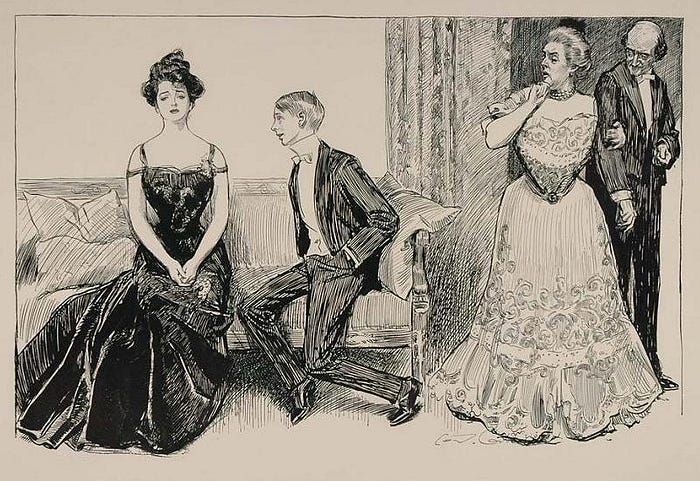
The Crush, Charles Dana Gibson, 1901 | Public Domain

The Advertising Campaign that Made Society Fear Sluts
At the turn of the twentieth century, society continued to have rigid ideas about sex.
But as morals loosened, there came a new tool to control sexual behavior — the Social Hygiene Campaign. Now, that might sound like a fancy way to scrub your kitchen counters, but this was a different kind of hygiene. The idea was that if folks kept their pants on, they would avoid all sorts of trouble and prevent venereal diseases from spreading like wildfire.
At the time, soldiers returning from World War I brought back with them not only scars and memories but also syphilis and gonorrhea. These diseases were highly contagious and, before the discovery of antibiotics, could cause serious health problems and death.
Unfortunately, the campaign quickly turned into your typical witch-hunt. Just like the Contagious Diseases Act of the previous century, authorities didn't need any evidence to drag a woman in for testing. Even something as innocuous as flirting with a soldier could get you in hot water. In one Louisiana town, a woman was forced to undergo a gynecological exam for dining alone in a restaurant. If a lady was foolish enough to eat alone, she must have a syphilitic brain.
Women of color were especially targeted. At the time, the medical community taught that non-white women were less moral and more likely to carry venereal diseases — a belief that persisted for decades.
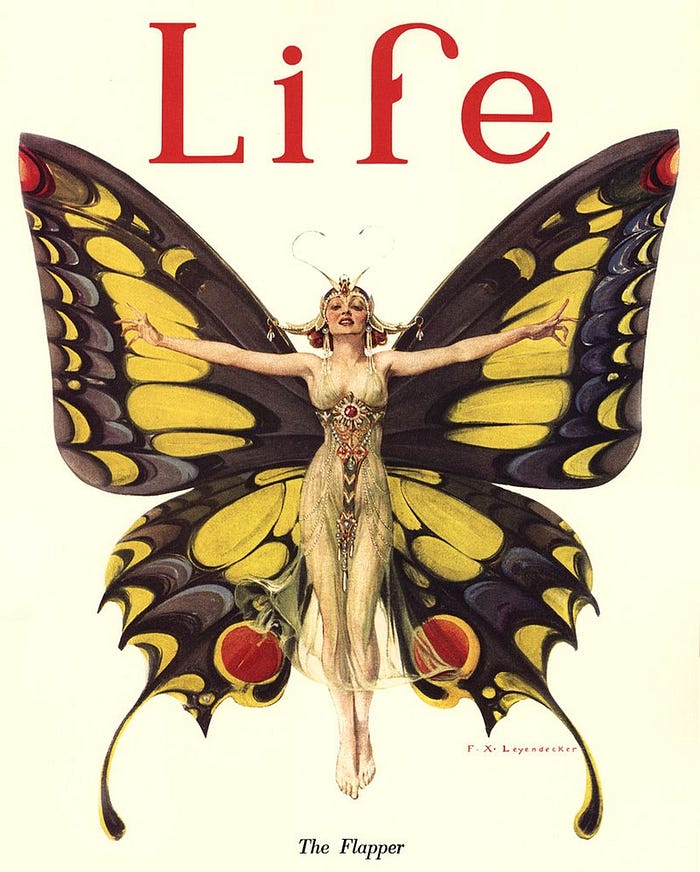
Life Magazine cover "The Flapper" by Frank Xavier Leyendecker, February 2nd, 1922| Public Domain

Charity Girls: The First Hookup Culture
The 1920s were a time of social upheaval in America. Women finally gained the right to vote, and with that newfound power came shorter hemlines and longer nights out. Prohibition only added to the madness, creating secret speakeasies and underground drinking establishments that fueled rebellion and excitement. Where there's drunkenness, there's debauchery.
The term "dating" entered the lexicon around this time, and young women who dated boys were called Charity Girls. These ladies basically exchanged their company for a meal or a movie ticket. They were often from working-class backgrounds and were unapologetic in their pursuit of pleasure, drawing the ire of many who viewed them as immoral and responsible for spreading venereal diseases. Because, of course, if you're having fun, you must be spreading disease.
To crack down on those frisky teens, President Wilson launched "purity campaigns" to warn young men about the dangers of venereal diseases. They went so far as to close down red-light districts and create "moral zones" around military training camps where women of ill repute were not allowed.
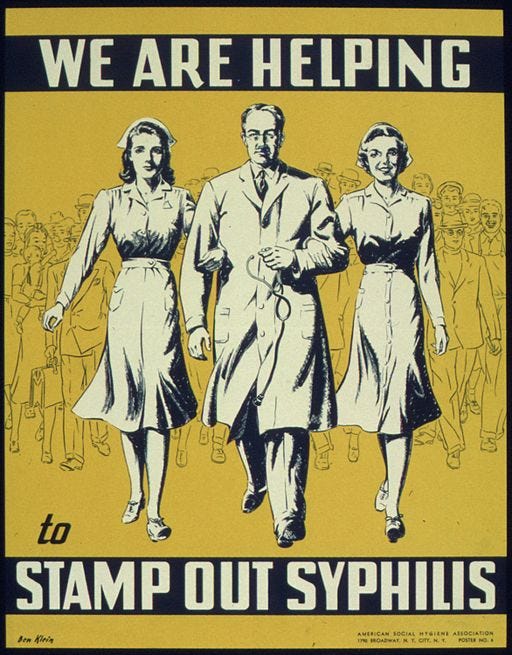
World War II public health posters, between 1942–1945 | Public Domain
Altogether, about 30,000 women were detained. Some were let go immediately. More than 18,000, however, were interned in federally financed facilities and subjected to forced medical treatment. Most historians believe the number of those detained was far more significant than federal records suggest because uncounted numbers of women were interned in local facilities.
And since penicillin was not discovered yet, substances like mercury, arsenic compounds, iodine, and silver nitrate were used. These treatments caused horrible side effects — tremors, insomnia, memory loss, neuromuscular effects, headaches, and cognitive and motor dysfunction.
I recently watched a disturbing video montage of all the celebrities who slut-shamed Britney Spears throughout her career. Most unsettling was a 2004 interview in which singer Avril Lavigne said Britney Spears dances "like a ho."
I found it ironic that a woman who branded herself as a tough, stick-it-to-the-patriarchy feminist would publically disparage a fellow artist for her sexuality.
But here we are. And while our knee-jerk reaction is to blame slut shaming on a history of male oppression, women's hands are not clean.
Today, when women are slut-shamed, they are not burnt as witches or imprisoned in hospitals, but they do experience feelings of self-doubt, as well as social alienation and bullying. More gravely, they may face sexual harassment and assault. By shaming women for their sexuality, we reinforce the idea that women are mere objects to be controlled and subjugated.
Recently, feminists have tried to reclaim the word slut with "slutwalks” and the anti-GOP Rock the Slut Vote political movement. Their efforts feel like a punchline to a joke no one gets. Women still must remain vigilant of how we take up space in public spheres, and society still promotes a hypersexualized ideal of beauty while warning women not to give men "the wrong idea."
You can’t change the meaning of a word when a word is this loaded with meaning.
Of course, language is a chimeric beast. Meanings expand, contract, and take on new forms. But let's not pretend that calling your friend a "slut” or “ho” as a term of endearment tames this dragon.
Or better yet, next time you castigate a woman for how she dresses, dances, or speaks, remember all the persecuted women throughout history who fought for the freedom to express their sexuality. They were the real powerful sluts.