12 KiB
title, source, author, published, created, description, tags
| title | source | author | published | created | description | tags | ||
|---|---|---|---|---|---|---|---|---|
| Keeping a suspense file gives you superpowers | https://doctorow.medium.com/https-pluralistic-net-2024-10-26-one-weird-trick-todo-txt-3a58188ba241 |
|
2024-10-26 | 2024-10-29 | I’ll be in Tucson, AZ from November 8–10: I’m the Guest of Honor at the TusCon science fiction convention. Two decades ago, I was part of a group of nerds who got really interested in how each other… |
|
Two decades ago, I was part of a group of nerds who got really interested in how each other managed to do what we did. The effort was kicked off by Danny O’Brien, who called it “Lifehacking” and I played a small role in getting that term popularized:
https://craphound.com/lifehacksetcon04.txt
While we were all devoted to sharing tips and tricks from our own lives, many of us converged on an outside expert, David Allen, and his bestselling book “Getting Things Done” (GTD, to those in the know):
https://gettingthingsdone.com/
GTD is a collection of relatively simple tactics for coping with, prioritizing, and organizing the things you want to do. Many of the methods relate to organizing your own projects, using a handful of context-based to-do lists (e.g. a list of things to do at the office, at home, while waiting in line, etc). These lists consist of simple tasks. Those tasks are, in turn, derived from another list, of “projects” — things that require more than one task, which can be anything from planning dinner to writing a novel to helping your kid apply to university.
The point of all this list-making isn’t to do everything on the lists. While these lists do help you remember what to do next, what they’re really good for is deciding what not to do — at all. The promise of GTD is that it will help you consciously choose not to do some of the things you set out to accomplish. This is in contrast to how most of us operate: we have a bunch of things we want to do, and we end up doing the things that are easiest, or at top of mind, even if they’re not the most important things.
GTD recognizes that you can be very “productive” (in the sense of getting many things done) and still not do the things that you really wanted to do. You know what this is like: you finish a Sunday with an organized sock-drawer, all your pennies neatly rolled, the trash-can in your car emptied…and no work at all on that novel you’re hoping to write.
You can’t do everything, but you can control what you don’t do, rather than just defaulting into completing a string of trivial, meaningless tasks and leaving the big stuff on the sidelines. Organizing your own tasks and projects is a hugely powerful habit, and one that’s made a world of difference to my personal and professional life.
But while good to-do lists can take you very far in life, they have a hard limit: other people. Almost every ambitious thing you want to do involves someone else’s contribution. Even the most solitary of projects can be derailed if your tax accountant misses a key email and you end up getting audited or paying a huge penalty.
That’s where the other kind of GTD list comes in: the list of things you’re waiting for from other people. I used to be assiduous in maintaining this list, but then the pandemic struck and no one was meeting any of their commitments, and I just gave up on it, and never went back…until about a month ago. Returning to these lists (they’re sometimes called “suspense files”) made me realize how many of the problems — some hugely consequential — in my life could have been avoided if I’d just gone back to this habit earlier.
My suspense file is literally just some lines partway down a text file that lives on my desktop called todo.txt that has all my to-dos as well. Here’s some sample entries from my suspense file:
WAITING EMAIL Sean about ENSHITTIIFCATION manuscript deadline 10/24/24
WAITING EMAIL Russ about missing royalty statement 10/12/24
WAITING EMAIL Alice about Christmas vacation hotel 10/8/24 10/20/24
WAITING EMAIL Ted about Sacramento event 8/12/24 9/5/24 10/5/24 10/20/24WAITING CALL LA County about mosquito abatement 10/25/24
WAITING CALL School attendance officer about London trip 10/18/24WAITING MONEY EFF reimbusement for taxi to staff retreat $34.98 10/7/24
WAITING SHIPMENT New Neal Stephenson novel from Bookshop.org 10/23/24
This is as simple as things could possibly be! I literally just type “WAITING,” then a space, then the category of thing I’m waiting for, then a few specifics, then the date. When I follow up on an item, I add the date of the followup to the end of the line. If I get some details that I might need to reference later (say, a tracking code for a shipment, or a date for an event I’m trying to organize), I’ll add that, too, as it comes up. Creating a new entry on this list takes 10–25 seconds. When someone gets back to me, I just delete that line.
That is literally it.
Every day, or sometimes a couple of times a day, I will just run my eyes up and down this list and see if there’s anything that’s unreasonably overdue, and then I’ll send a reminder or make a followup call. In the example above, you can see that I’ve been chasing Ted about Sacramento for months now (this is a fake entry — no plans to go to Sacto at the moment, sorry):
WAITING EMAIL Ted about Sacramento event 8/12/24 9/5/24 10/5/24 10/20/24
So now I’ve emailed Ted four times. Maybe my email’s going to his spam, and so I could try emailing a friend of Ted and ask them to check whether he’s getting my messages. But maybe Ted’s trying to send me a message here — he’s just not interested in doing the event after all. Or maybe Ted is available, but he’s so snowed under that he’s in danger of fumbling it, and I need to bring in some help if I want it to happen.
All of these are possibilities, and the fact that I’m tracking this means that I now get to make an active decision: cancel the gig or double down on making sure it happens. Without this list, the gig would just die by default, forgotten by both of us. Maybe that’s OK, but I can’t tell you how many times I’ve run into someone who said, “Dammit, I just remembered I was supposed to email you about getting that thing done and I dropped the ball. Shit! I really was looking forward to that. Is it too late now?” Often it is too late. Even if it’s not, the work of picking up the pieces and starting over is much more than just following through on the original plan.
Restarting my suspense file made me realize how many of the (often expensive or painful) fumbles I’ve had since the pandemic were the result of me not noticing that someone else hadn’t gotten back to me. In essence, a suspense file is a way for me to manage other people’s to-do lists.
Let me unpack that. By “managing other people’s to-do lists,” I don’t mean that I’m deciding for other people what they will and won’t do (that would be both weird and gross). I mean that I’m making sure that if someone else fails to do something we were planning together, it’s because they decided not to do it, not because they forgot. As GTD teaches us, the real point of a to-do list isn’t just helping us remember what to do — it’s helping us choose what we’re not going to do.
This is not an imposition, it’s a kindness. The point of a suspense file isn’t to nag others into living up to their commitments, it’s to form a network of support among collaborators where we all help one another make those conscious choices about what we’re not going to do, rather than having the stuff we really value slip away because we forgot about it.
I have frequent collaborators whom I know to be incapable of juggling too many things at once, and my suspense file has helped me hone my sense of when it would be appropriate to ask them if they want to do something together and when to leave them be. The suspense file helps me dial in how much I rely on each person in my life (relying on someone isn’t the same as valuing them — and indeed, one way to value someone is to only rely on them for things they’re able to do, rather than putting them in a position of feeling bad for failing you).
Lifehacking gets a bad rap, and justifiably so. Many of the tips that traffick as “lifehacks” are trivial or stupid or both. What’s more, too much lifehacking can paint you into a corner where you’ve hacked any flexibility out of your life:
https://locusmag.com/2017/11/cory-doctorow-how-to-do-everything-lifehacking-considered-harmful/
But ever since Danny coined the term “lifehack,” back in 2004, I’ve been cultivating daily habits that have let me live the life I wanted to live, accomplishing the things I wanted to accomplish. I figured out how to turn daily writing into a habit and now I’ve written more than 30 books:
https://www.locusmag.com/Features/2009/01/cory-doctorow-writing-in-age-of.html
A daily habit of opening a huge, ever-tweaked collection of tabs has made me smarter about the news, helped me keep tabs on my friends, helped me find fraudsters who were trying to steal my identity, and ensured that all those Kickstarter rewards and other long-delayed, erratic shipments didn’t slip through the cracks:
https://pluralistic.net/2024/01/25/today-in-tabs/#unfucked-rota
==Daily habits are superpowers. Once something is a habit, you get it for free.== GTD turns on decomposing big, daunting projects into bite-sized, trackable tasks. I have a bunch of spaces around the house — my office, my closet, the junk sheds down the side of the house, our tiki bar — that I used to clean out once or twice a year. Each one was all-day, sweaty, dirty job, and for most of the year, all of those spaces were a dusty, disorganized mess.
A month ago, I added a new daily task: spend five minutes cleaning one space. I did the bar first, and after two weeks, I’d taken down every tchotchke and bottle and polished it, reorganizing the undercounter spaces where things pile up:
Now I’m working through my office. Ever day, I’m dusting a bookshelf and combing through it for discards to stick in our Little Free Library. Takes less than five minutes most day, and I’ll be done in about three weeks, when I’ll move on to my closet, then the side of the house, and then back to the bar. A daily short break where I get away from my computer and make my living and working environments nicer is a wonderful habit to cultivate.
I’m 53 years old now. I was 33 when I started following Getting Things Done. In that time, I’ve gotten a lot done, but what’s even more relevant is that I didn’t get a ton of things done — things that I consciously chose not to abandon. Figuring out what you want to do, and then keeping it on track — in manageable, healthy, daily rhythms that bring along the other people you rely on — may not be the whole secret to a fulfilled life, but it’s certainly a part of it.
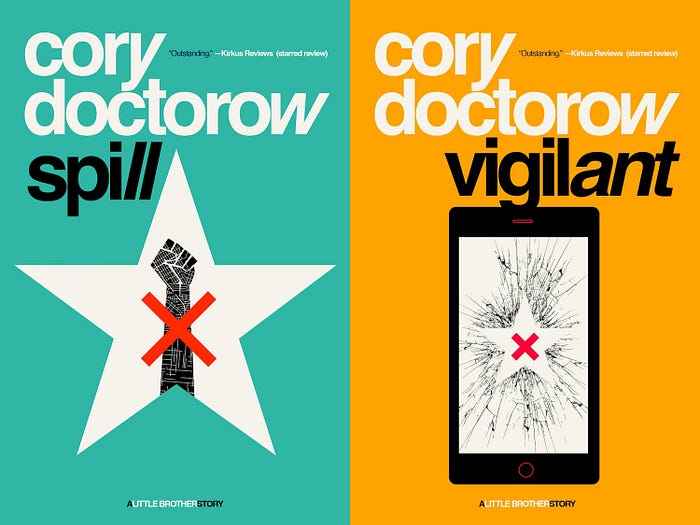
Tor Books just published two new, free “Little Brother” stories: “Vigilant,” a about creepy surveillance in distance education; and “Spill,” about oil pipelines and indigenous landback.